


A Pitchers Job

Updated: Mar 21, 2022
Before I get started, I need to credit Dr. Adam Naylor for the concept I am going to discuss. Dr. Naylor was my sports psychologist in college and you can find him on twitter @ahnaylor and https://telos-spc.com/
_______________________________________________________________________________________________________________________
What is a pitcher's job?
This is a question that I have heard dozens of different answers to.
The 2 most common answers I hear are:
Throw Strikes
Get Outs
I don’t think many people would argue with this.
By the definition of how baseball works, yes, a pitcher NEEDS to throw strikes to be successful.
By the definition of how baseball works, yes, a pitcher NEEDS to get outs to be successful.
But if we are trying to boil it down to the purest, most singular task, neither of these answers can be right because they both fail to consider external factors.
A constant mantra in baseball (really something you hear in all sports and just in life in general) is CONTROL THE CONTROLLABLES. I’m sure everyone has heard this in some shape or form before.
You can only control what YOU do, and nothing else. Let's look at these answers through the lens of “control”.
Does the pitcher CONTROL if a pitch is a ball or a strike?
Before I expand on this, I would like to point out that the strike zone is an arbitrary, imaginary “box” that we rely on human officials to determine, but I digress…

Does the pitcher CONTROL if a pitch is a ball or a strike?
The answer is no. That is the job of the umpire.
We have all seen questionable umpiring where the umpire falls to recognize a swing (an egregious example seen here) or calls a ball on a pitch that is seemingly in the heart of the zone.
A pitcher CANNOT control if the pitch is a ball or strike.
Does the pitcher CONTROL if a batter gets out?
The answer is no. The only time you could make an argument for this to be “yes” is if the pitcher strikes out every out of the game.
The problem with that unlikely scenario is to strike out 27 hitters you need to throw at least 81 strikes. As we have already determined, you don’t control balls/strikes, so it's a moot point - but for the sake of argument let’s look at strikeouts as a way a pitcher can control outs.
The most strikeouts ever recorded in a major league baseball game is 20 (and this has only happened FOUR TIMES). In each of these historic games, 7 outs had to be made by people other than the pitcher, IE, the out is not determined by the pitcher.
Side note, if you have never watched the highlights from Kerry Wood's 20K game, please do yourself a favor and
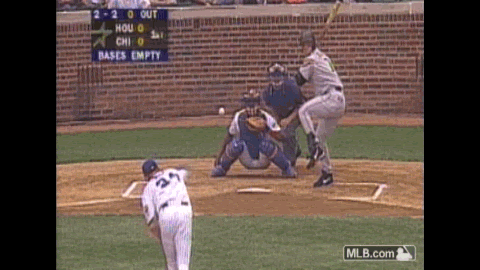
go watch it when you're done reading this post! (HERE IS THE LINK)
But how many times have you seen a fielder make an error on a routine play? Too many times to count I’m sure. On the flip side, how many times have you seen the pitcher let up a missile that gets caught? So sometimes the pitcher can “beat” the batter and not get an out, and other times get beat by the batter and get an out. That does not sound like control to me.
So if a pitcher can not control balls vs. strikes, and can not control whether or not a batter gets out, WHAT IS HIS JOB?
How do we boil it down to its simplest and purest form? How can we simplify pitching so that we are focusing on 1 thing rather than 100? We need to take all external factors out of it and determine what singular thing a pitcher NEEDS to do that he can actually control.
So what is my answer to this question?
A pitcher's job, simply put, is to THROW GOOD PITCHES.
Now this is obviously easier said than done. Pitching is very difficult, but the pitchers who have the most success are the ones who have the ability to execute good pitches.
Can you throw the pitch where you want to? Can you throw it at an efficient speed in comparison to your other pitches? Can you make it move the way you want it to? These are all things a pitcher can practice and learn to control.
I can rant all day about this topic and discuss what the difference is between a good pitch and a bad pitch, pitch design, the evolution of skill development, etc. but I won’t…for now.
The most important thing to take away is this:
Pitching is really hard. The more you can simplify it, the better off you will be. Your goal as a pitcher should be to throw good pitches. If you throw good pitches more often than not, you will almost certainly have success.

Comments